
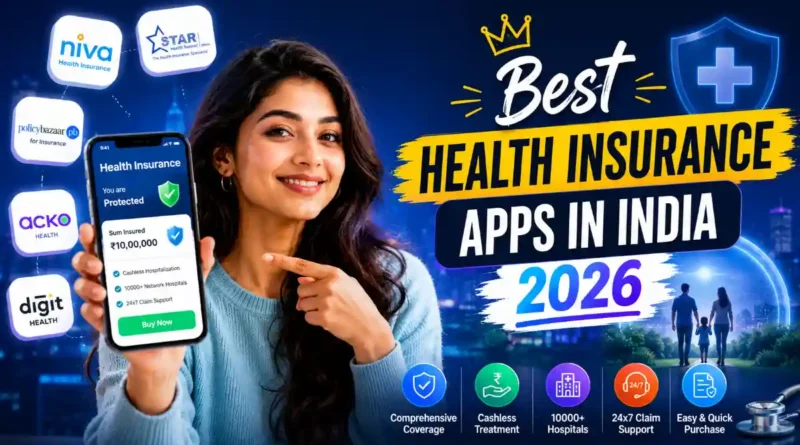
Best Health Insurance Apps in India 2026
Health insurance is no longer just a policy tucked inside a drawer. In 2026, it lives on your smartphone – accessible, manageable, and surprisingly personal. As India’s digital health ecosystem has matured dramatically over the past few years, a new generation of health insurance apps has emerged that genuinely changes the way people buy, manage, and claim their coverage.
Whether you are a salaried professional in Bengaluru, a self-employed entrepreneur in Jaipur, or a senior citizen in Kolkata navigating medical costs, there is an app built with your needs in mind.
This article walks you through the best health insurance apps available in India right now, what makes each one stand out, and what you should look for before downloading.
Why Health Insurance Apps Matter More Than Ever
India’s healthcare costs have been rising at a pace that outstrips general inflation. A single hospitalization can cost anywhere from ₹50,000 to several lakhs depending on the city, the hospital, and the nature of treatment. At the same time, out-of-pocket health expenditure among Indian households remains among the highest in Asia.
Health insurance apps address a very real problem: they make it easier to stay covered, stay informed, and stay in control. Gone are the days when you had to call a toll-free number to understand your policy or physically visit a branch to file a claim. Today, the best apps offer instant cashless claim approvals, AI-powered symptom checkers, telemedicine consultations, and policy comparisons — all from a single screen.
1. Niva Bupa Health App
Niva Bupa (formerly Max Bupa) has built one of the cleanest and most intuitive health insurance apps in the country. The app allows policyholders to raise and track cashless claims in real time, view their policy documents, and book consultations with network doctors.
What truly sets Niva Bupa apart in 2026 is its Health ReturnsⓇ feature, which rewards users with premium discounts when they maintain healthy habits tracked through the app — such as step counts and annual health check-ups. It essentially gamifies wellness, which is a thoughtful approach to reducing long-term claims.
The app also integrates with the Ayushman Bharat Digital Mission (ABDM), which means your health records are linked and accessible in a standardized format across providers.
Best for: Individuals and families who want a premium insurer experience with wellness rewards.
2. Star Health Insurance App
Star Health is one of India’s largest standalone health insurers, and their app reflects that scale. The interface is straightforward and designed with a wide demographic in mind — including older users who may not be particularly tech-savvy.
Key features include instant policy issuance, a hospital locator with over 14,000 network hospitals, and a dedicated claims tracker. The app allows pre-authorization for planned surgeries, which can significantly reduce paperwork stress during an already anxious time.
In 2026, Star Health has also introduced a video claim assistance feature, where a claims executive joins a video call to help customers navigate the documentation process. This human-in-the-loop approach is particularly valuable for first-time claimants.
Best for: Senior citizens and families looking for wide hospital network coverage with easy navigation.
3. Care Health Insurance App (formerly Religare)
Care Health has consistently impressed with its digital infrastructure. The app is sleek, fast, and packed with features that go beyond basic policy management. Policyholders can access unlimited teleconsultations, get second medical opinions, and order medicines — all within the same app ecosystem.
The Care with Benefits add-on, accessible through the app, bundles OPD (outpatient) coverage into what traditionally was only an IPD-focused product. In a country where most doctor visits are OPD in nature, this is a meaningful evolution.
Care Health also stands out for its transparency — the app clearly displays what is covered, what is excluded, and what waiting periods apply. There is no fine print hidden under confusing menus.
Best for: Urban professionals who want comprehensive coverage including OPD and digital health services.
4. Digit Health Insurance App
Go Digit has disrupted the insurance space with its plain-language policies and no-nonsense approach. Their health insurance app carries that same DNA. Policies are explained in simple English (and several regional languages), claims are self-serviced through a guided step-by-step process, and the entire onboarding takes less than ten minutes.
Digit’s app shines particularly in its self-declaration model for pre-existing conditions, which reduces the friction typically associated with medical underwriting. In 2026, they have also rolled out an AI-based claims estimation tool that gives users a rough sense of what their claim might settle at — before they even submit it.
Best for: First-time insurance buyers who want simplicity and speed without confusing jargon.
5. PolicyBazaar App
PolicyBazaar is not an insurer itself, but its app deserves a prominent place on this list because it functions as the most powerful health insurance aggregator in India. If you are still deciding which policy to buy, this is where your journey should begin.
The app lets you compare premiums, coverage limits, sub-limits, waiting periods, and network hospitals across dozens of insurers simultaneously. Its AI recommendation engine has improved significantly and now factors in your city, age, family composition, and existing medical conditions to suggest genuinely suitable plans.
The 2026 version also includes a policy audit feature, where existing policyholders can upload their current policy and receive an independent assessment of whether they are under-insured, over-paying, or missing critical riders.
Best for: Anyone comparing options before buying, or those wanting to review and upgrade existing coverage.
What to Look for in a Health Insurance App
Choosing an app is really about choosing an insurer and a product. But the app itself should meet certain standards. Look for:
- Cashless claim speed: The best apps process pre-authorization within hours, not days.
- Hospital network search: A robust, GPS-enabled search for nearby empanelled hospitals is essential.
- Document storage: Your policy, ID cards, and claim documents should be stored securely within the app.
- Customer support: Live chat or video support, not just a bot, matters when things go wrong.
- ABDM integration: Apps linked to the national health ID ecosystem offer better continuity of care.
Conclusion
India’s health insurance penetration, while improving, still lags significantly behind global averages. Apps are a critical bridge — lowering the barrier to entry, simplifying the claims experience, and building trust in a sector that has historically suffered from opacity.
The best health insurance apps in 2026 are not just digital replicas of paper policies. They are active health management tools. They remind you to renew before lapsing, alert you when a family member is admitted, and help you make sense of a medical bill at 2 AM when no agent is available.
In a country where healthcare needs can arrive without warning, having the right app on your phone is not a luxury — it is a form of preparedness.
Choose wisely, stay covered, and let technology work in your favour.